
Original article (in Serbian) was published on 9/4/2026; Author: Stefan Kosanović
Albanian minority students in Skopje protested in early April demanding the right to take the bar exam in their native language, saying North Macedonia’s Law on the Use of Languages is not being implemented in practice. The students said they resorted to protests after institutions failed for years to respond to their requests and appeals. Serbian outlet Vaseljenska portrayed the rally as part of a broader nationalist agenda tied to the idea of a “Greater Albania,” a characterization the students rejected as misleading.
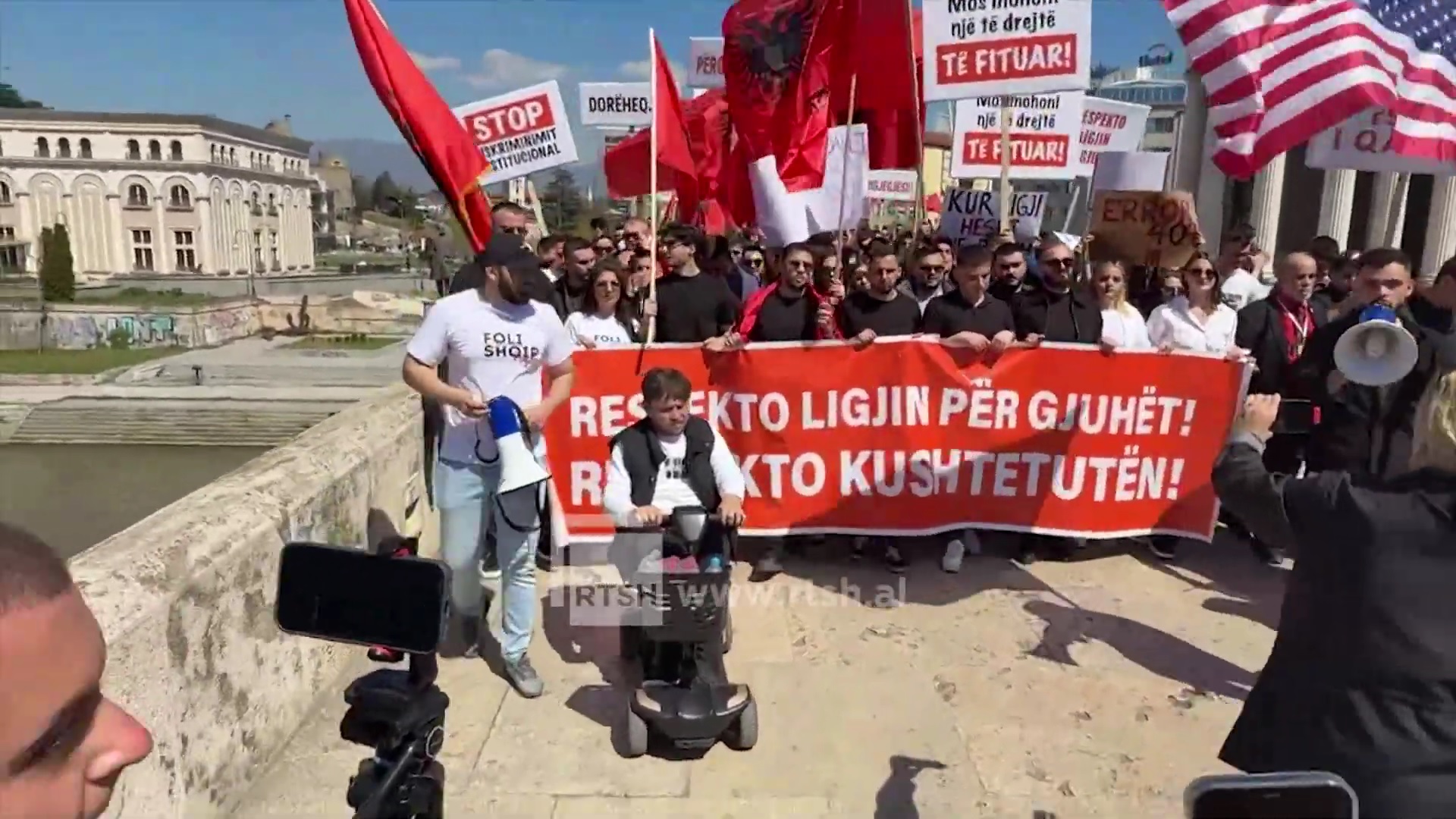
Students from North Macedonia’s Albanian minority marched through Skopje in early April demanding the right to take the bar exam in Albanian, expressing frustration over what they described as the authorities’ failure to enforce the country’s Law on the Use of Languages.
The law provides for the official use of Albanian in state institutions, including the right to use the language in education, as Albanians make up a significant share of the country’s population.
The protest began at Karpoš Uprising Square and ended outside the Justice Ministry.
Demonstrators carried Albanian and U.S. flags, while the protest received support from Albanian political parties in Kosovo, former Kosovo President Vjosa Osmani and veterans’ organizations linked to the Kosovo Liberation Army (KLA).
The rally also drew the attention of several Serbian tabloids.
“Albanians will ‘swallow’ the Macedonians?! Chaos begins in Skopje: Albanians take to the streets, mass demonstrations announced,” Serbian tabloid Informer wrote, while portal Vaseljenska described the protesters as “followers of ‘Greater Albania’ blocking the Macedonian capital.”
Vaseljenska adopted a strongly partisan tone, claiming the Albanian diaspora “has not given up attempts to attach this once Slavic state of the Western Balkans to its ‘Greater Albania’ project.”
Mevlan Memedi, a student from Skopje, told Raskrikavanje that no participant had mentioned the idea of “Greater Albania,” accusing some media outlets of twisting legitimate demands into unfounded nationalist narratives.
“Our goal was clear: to allow Albanian students to take the bar exams in the language in which we study, and nothing more,” Memedi said. “Anyone trying to present this differently is in fact trying to inflame interethnic tensions in the Balkans.”
Memedi said students turned to protests after exhausting institutional channels without receiving any response.
“We felt the need for our voice to be heard in a peaceful and democratic way,” he added.
Vaseljenska also claimed that “young Albanians behaved aggressively, shouting, whistling and chanting slogans.”
Memedi denied the allegations, saying the protest passed without incidents or unrest.
“After two years of attempts to contact the justice minister so that the Law on the Use of Languages and the Constitution would be applied regarding the bar exam in Albanian — the language in which we study — we were met only with silence,” Memedi told Raskrikavanje.
“We faced what can only be described as institutional neglect, which culminated in a peaceful protest with one single demand: for the minister to implement the law, because this is our guaranteed right.”
Russian state-affiliated outlet Sputnik reported that chants of “KLA” could be heard during the demonstration.
Memedi confirmed that some individuals shouted the slogan, but said it was not an organized part of the protest.
“If you watch the entire footage, you will see that throughout the march the slogans were: ‘We study in Albanian,’ ‘There is no state without its youth,’ and ‘Equality,’” he said.
“Yet somehow, five seconds of chants of ‘KLA’ receive more media attention than an hour of chants of ‘Equality.’”
North Macedonia’s government blamed the situation on the previous administration.
Prime Minister Hristijan Mickoski said the former government had passed the Law on Languages, but that the section concerning the judiciary had been challenged before the Constitutional Court.
“We have a negative opinion from the Venice Commission, which says bilingualism in the judiciary should be abandoned because there are challenges, most often related to the rule of law,” Mickoski said.
He added that the government had formed a group of constitutional law experts to work on a solution that would be constitutional and in line with international standards, and said a solution would be found “for many of the challenges and mistakes of the past.”