
Original article (in Serbian) was published on 22/5/2026; Author: Milica Ljubičić
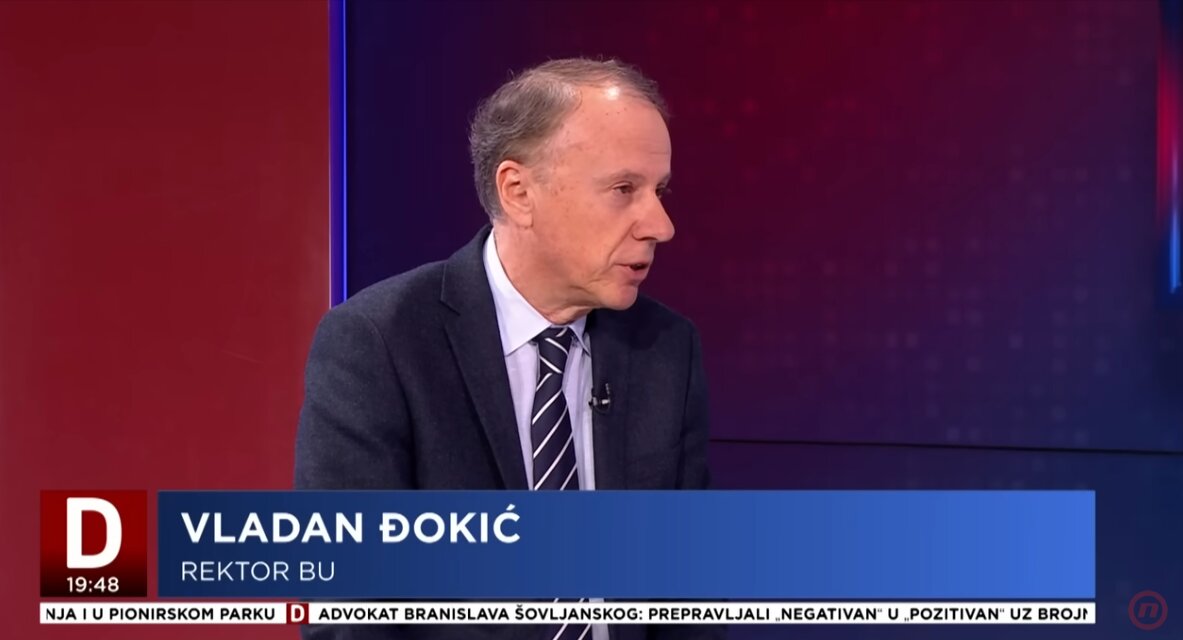
Belgrade University rector Vladan Đokić has for months been the target of attacks by pro-government tabloids over his support for student protests. The latest wave of attacks comes as tabloids accuse him of “robbing the state and students.” They reached this conclusion after several faculties at the University of Belgrade decided to raise tuition fees for the next academic year. However, the decision was prompted by inflation and rising faculty costs, two faculties confirmed to Raskrikavanje.
Pro-government tabloid Informer, which has been targeting the rector for months, is now accusing him of being responsible for the tuition increases introduced by several University of Belgrade faculties for the upcoming academic year.
“Đokić is robbing the state and students. Faculties have increased tuition fees without justification, and since the state covers 50 percent of those costs, Rector Vladan Đokić’s intention to extract money from the budget is obvious,” Informer wrote in its May 20 print edition.
Throughout the article, the tabloid insists that faculties are raising tuition fees “without any reason whatsoever.”
Although these accusations create the impression that the rector is responsible for tuition fees, decisions on tuition amounts are made by the higher education institutions themselves.
Serbia’s Law on Higher Education states that tuition fees are determined through a general act adopted by the higher education institution, while the institution’s council – composed of at least 17 members – “adopts the decision on tuition fees upon the proposal of the expert body.”
Do the University of Belgrade and the rector have any role in determining tuition fees?
According to the University of Belgrade’s Statute, tuition fees are set by the individual higher education institutions themselves.
The statute states that tuition covers “fees for regular services provided by the faculty within the study program for one academic year,” adding that these “regular services are determined by the University Senate.”
The Senate of the University of Belgrade is the university’s highest professional body and, in addition to the rector, consists of 51 members, including vice-rectors, faculty deans and institute directors.
However, the university statute does not explicitly stipulate that the Senate approves or rejects tuition fee proposals submitted by faculties.
This means that the university rector does not have the authority to independently determine or increase tuition fees at faculties, despite the impression created by Informer’s article.
Among the faculties that will increase tuition fees next academic year is the Faculty of Organizational Sciences (FON).
The faculty told Raskrikavanje that inflation was the reason behind the increase.
“FON increased tuition from 171,000 dinars to 180,000 dinars, which represents an increase of around five percent, in line with the inflation rate over the past two years,” the faculty said.
Other University of Belgrade faculties set to increase tuition next year include the Faculty of Law, Faculty of Philology, Faculty of Mechanical Engineering, Faculty of Sport and Physical Education, Faculty of Economics and the Technical Faculty in Bor, which is also part of the university.
The dean of the Technical Faculty in Bor, Dejan Tanikić, told Raskrikavanje that tuition fees had not been changed since 2022 and that the decision was made due to rising costs.
“Due to increased fixed maintenance costs at the faculty, higher costs of equipment, materials and education, as well as all accompanying expenses, the faculty council decided to raise tuition by 10,000 dinars, bringing it to 70,000 dinars. I would also note that, compared with tuition fees at other University of Belgrade faculties, it remains among the lowest,” he said in an email to Raskrikavanje.
He added that the University of Belgrade “has absolutely no influence over decisions regarding tuition fees at faculties within its system, including the tuition fees of the Technical Faculty in Bor.”
It should be recalled that after months of student protests and university blockades across Serbia, the government last year amended the Law on Higher Education.
The amendments included a 50 percent reduction in tuition costs.
More precisely, as stated in the law, self-financing students “are entitled to reimbursement of 50 percent of the costs corresponding to the reference tuition fee they paid during the current academic year.”