

Original article (in Croatian) was published on 29/5/2026; Author: Matea Grgurinović
An old statement by the Director General of the Croatian Meteorological and Hydrological Service (DHMZ) about cloud seeding has resurfaced on social media. Remarks by Dr Ivan Güttler have been taken out of context in an attempt to revive the long-running conspiracy theory about so-called “chemtrails.”
False claims and misinformation about weather manipulation frequently circulate on social media. Faktograf has now come across a viral Facebook post recycling a two-year-old television appearance by Dr Ivan Güttler, Director General of the Croatian Meteorological and Hydrological Service (DHMZ), on Croatia’s public broadcaster HRT. In the interview, Güttler criticised cloud seeding as a method of hail suppression. His remarks have been taken out of context and presented as an admission that DHMZ deliberately causes severe weather events, linking them to the conspiracy theory surrounding so-called “chemtrails.”
“Here, the president of the Croatian Hydrometeorological Institute is finally explaining it to you (that they don’t suppress hail, they actually cause it… poor guy has to say it because it’s legally mandatory 😈🤡). For all the idiots who think DRAWING LINES ACROSS THE SKY is a natural phenomenon… we haven’t fallen off the edge of the Earth yet, while you eat silver iodide every day,” the Facebook post (archived here) states.
The post, a screenshot of which is shown below, has received 2,700 reactions, 381 comments, has been shared 2,000 times, and has accumulated nearly 95,000 views.
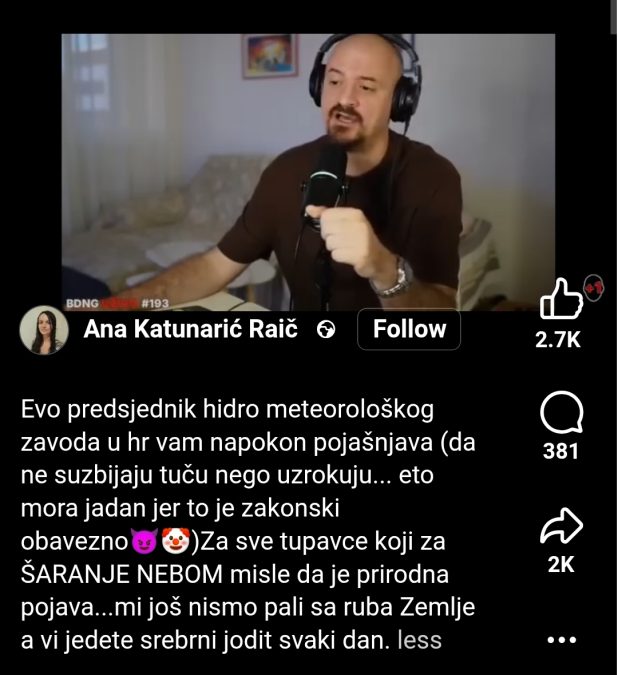
As noted above, the video accompanying the post uses excerpts from Güttler’s appearance on HRT’s current affairs programme Otvoreno.
The 4-minute and 50-second video claims that Croatia is “the only country in the EU legally required to seed clouds with silver iodide.” It then shows excerpts from Güttler explaining that DHMZ is indeed the only national meteorological service in the European Union with a legal obligation to seed convective clouds with silver iodide as part of hail suppression efforts.
“When we talk about the effectiveness of this system, this has been a topic of intense public debate in Croatia for at least twenty years. However, the only proper scientific research was conducted in the 1970s – not in Croatia, unfortunately, nor in the former Yugoslavia, but in places such as Switzerland and Colorado in the United States. The studies followed the same logic as clinical drug trials: one hundred clouds were seeded, another one hundred were not. Some of the results are fascinating. They actually show that the application of silver iodide increases hail damage,” Güttler says, among other things.
DHMZ has long criticised cloud seeding
For years, the Director General of DHMZ has consistently criticised cloud seeding as a method of hail suppression, explaining that there is no scientific evidence demonstrating its effectiveness. This position is also reflected on DHMZ’s official website.
It is true that in a 2024 interview, Dr Ivan Güttler stated that DHMZ is the only national meteorological service in the European Union that is legally required to seed convective clouds with silver iodide for hail suppression.
He also referred to studies suggesting that the use of silver iodide may actually increase hail damage and explained that this is why DHMZ approaches the practice with caution.
“Hail is a serious problem with the potential to cause major damage. But cloud seeding with silver iodide is ineffective and potentially dangerous. I will keep repeating this every year,” Güttler also wrote on his social media account at the time.
In 2018, at the request of the Ministry of Agriculture, DHMZ produced an analysis examining the effectiveness of Croatia’s hail suppression system. The analysis concluded that there is no scientifically substantiated evidence showing that Croatia’s hail defence programme is either effective or economically justified. According to DHMZ, public funds would be better invested in preventing and mitigating the consequences of other extreme weather events, such as floods, droughts and strong winds.
What is cloud seeding?
To reiterate, the phenomenon of “cloud seeding” – that is, attempts to artificially induce rainfall – has long been a popular topic among those spreading misinformation online.
Cloud seeding is by no means a new technology. It has been experimented with for decades, and its effectiveness remains a subject of scientific debate. Its primary purpose is to increase precipitation.
Some scientists believe cloud seeding has potential, while others remain sceptical because no one has yet conclusively demonstrated that it actually increases rainfall or snowfall beyond what would have occurred naturally.
The technology itself is relatively straightforward. Various substances – most commonly silver iodide – are introduced into clouds to act as nuclei around which water vapour can condense, thereby encouraging precipitation.
However, even under the most favourable conditions, this technology can only stimulate existing clouds to produce somewhat greater amounts of rain. There is no evidence whatsoever that cloud seeding can generate destructive storms such as those that have increasingly affected Croatia in recent years.
Hail suppression
Hail suppression programmes using rockets were implemented in Croatia for many years (and earlier in Yugoslavia) before eventually being abandoned. Over time, scientific evidence demonstrated that such systems were ineffective, as they have no measurable influence on the likelihood of hail occurring over a given area.
Hail suppression is itself a form of cloud seeding. The most commonly used substance is again silver iodide, which is dispersed into the atmosphere either by rockets or ground-based generators. The underlying idea is that this process can disrupt the formation of large hailstones within storm clouds.
Because Croatia periodically revisits public debate over reintroducing rocket-based hail suppression – typically after hailstorms damage agricultural areas – and because the proposal continues to receive political support, DHMZ has published detailed explanations of why such programmes lack scientific justification.
“Over the past two decades, many countries around the world have discontinued operational hail suppression. Some countries still maintain such programmes, but with questionable results. The prevailing opinion within the scientific and professional community is that there is currently no effective operational defence against hail,” DHMZ states.
Besides being ineffective, the method may also have adverse environmental consequences. The most effective way to reduce extreme weather events, including hailstorms, is through climate action – that is, a well-planned, systematic and gradual decarbonisation of the global economy.
Continued use
Despite the lack of convincing scientific evidence supporting their effectiveness, cloud seeding programmes continue to operate in more than 50 countries, according to a 2017 estimate by the World Meteorological Organization (WMO). In Croatia, rockets are no longer used, but silver iodide continues to be released into the atmosphere through ground-based generators.
Experts generally regard the system as, at best, ineffective and, at worst, environmentally harmful. Nevertheless, it continues primarily for political reasons. Farmers facing increasingly frequent hail damage demand that the government take action. Calls also periodically emerge to restore rocket-based hail suppression, which some farmers believe was more effective than the current ground generators. The main argument is that hail damage used to be lower when rockets were still employed. While it is true that damage from extreme weather events has increased over time, this is attributable to climate change rather than changes in hail suppression technology.
The World Meteorological Organization maintains a cautious position on weather modification. In its official statement, WMO emphasises that it neither promotes nor discourages weather modification but instead focuses on encouraging scientifically grounded research and providing guidance on best practices.
“It should be understood that the energy involved in weather systems is so enormous that it is impossible to create rain-producing clouds, alter wind patterns to transport water vapour to a desired area, or eliminate severe weather events. Weather modification technologies claiming to achieve such large or dramatic effects have no solid scientific basis and should be treated with scepticism,” WMO states.
Güttler: Three issues are constantly being confused
Following renewed circulation of his 2024 interview, Güttler responded on Facebook, stating that he stands by everything he said while stressing the importance of “calmly separating three issues that are constantly being confused in public debate.”
“1) Cloud seeding (AgI): a real meteorological technique that has been used for decades, primarily for hail suppression and precipitation enhancement. Ground-based generators and rockets are simply methods of delivery. Questions about its effectiveness, cost, and the long-term impact of silver iodide on soil and water are legitimate topics for discussion. I have no problem with that.
2) Aircraft condensation trails (contrails): water vapour from aircraft engines that freezes at high altitude in low temperatures and becomes visible. This is physics, not chemistry. Contrails have absolutely nothing to do with cloud seeding.
3) The theory that aircraft are deliberately ‘spraying’ the population: there is no evidence for this claim, and it simply confuses the first two issues.
Some citizens strongly support keeping the ground generators and bringing back rockets. I understand that. A farmer who has lost an entire crop to hail is not looking for theories; they are looking for protection. Operational hail suppression deserves a serious discussion based on evidence, without ridiculing either side. But confusing cloud seeding with contrails and conspiracy theories helps no one – not those seeking protection from hail, nor those who are genuinely concerned about the air they breathe,” Güttler wrote.
In conclusion, unsubstantiated claims about weather modification and cloud seeding are once again circulating on Facebook. The post uses excerpts from an old interview with DHMZ Director General Ivan Güttler, in which he actually criticises cloud seeding as part of Croatia’s hail suppression system. His remarks have been taken out of context to create the false impression that Güttler admitted DHMZ deliberately causes severe weather events, thereby lending support to the long-standing conspiracy theory about so-called “chemtrails.”