

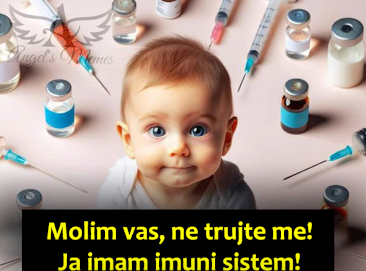
“Please do not poison me. I have an immune system,” reads the caption beneath an image of a baby surrounded by vaccine needles. The AI-generated infant stares directly at the viewer, invoking innocence corrupted by adults who choose to vaccinate their children. Accompanied by anti-vaccination claims and widely shared in anti-vaxxer communities, the image is only one example of how children are instrumentalized to promote political and ideological agendas.
Children are among the most vulnerable groups in society, but they are also symbolically sacred across cultures and political systems. This makes them especially useful in disinformation campaigns. They function as emotionally uncontestable symbols capable of provoking outrage, fear, and moral panic more effectively than almost any other social group.
Disinformation involving children is particularly common in health-related topics, according to Milica Ljubičić from the Serbian fact-checking outlet Raskrikavanje. She highlighted vaccine-related narratives, especially recurring false claims about the MMR vaccine allegedly causing autism, despite the study behind that claim having been debunked years ago.
“These claims are extremely dangerous because many parents, out of fear that vaccines will harm their children’s health, decide not to vaccinate them,” Ljubičić told SEE Check.
Children are also frequently used in narratives warning against the so-called “LGBTIQ agenda.” In such claims, children are portrayed as being endangered by LGBTIQ individuals or by alleged institutional attempts to “indoctrinate” them. Some examples include false claims that the EU issued a ruling forcing Hungarian children to be exposed to LGBTIQ content, or that a kindergarten for LGBTIQ children existed in Berlin. Through narratives like these, disinformation actors advance broader homophobic agendas by framing children as victims under threat.
“In our region, the topic of sexual education in schoolbooks is heavily exploited. The political right immediately becomes alarmed and begins spreading disinformation about how it will negatively affect children. They play precisely on the fact that children are the issue we are most sensitive about,” said Ljubičić.
In this way, children become what researchers often describe as “moral triggers” within disinformation ecosystems — symbols designed to provoke fear, outrage, and protective instincts.
Psychotherapist Nijaz Omanović explained the psychological mechanisms behind this process to SEE Check:
“When we observe the broader social context and its impact on individuals, adults are encouraged to internalize the idea that if a child is not safe or protected within a community, then nobody is safe.”
Political Abuse of Children
The political instrumentalization of children is not limited to conspiracy theories or moral panic. Children are also frequently used in political campaigns and nationalist mobilization.
“How dare they call me Bosnian! I’m Bosniak,” says a young boy in a controversial nation-building campaign ahead of the 2013 census in Bosnia and Herzegovina. The campaign aimed to encourage citizens to declare themselves ethnically as Bosniaks rather than nationally as Bosnians. Although directed at adults, the campaign relied on children as symbols of a future that needed to be protected and ideologically shaped. The campaign ultimately backfired, and the instrumentalization of children was widely criticized.
In neighboring Serbia, the ruling Serbian Progressive Party (SNS) was similarly condemned for using a little girl in a 2020 election campaign video. The country’s Regulatory Authority for Electronic Media fined the party, and the campaign sparked significant public criticism.
There is at least some societal awareness that children should not be used for political promotion or ideological messaging. Yet while such misuse is easier to recognize in overt political campaigns, it becomes more difficult to detect when children are used indirectly to legitimize broader ideological narratives or moral agendas. Ljubičić gives an example of current anti-government protests, ongoing for almost two years.
“Even today, after nearly two years of protests and blockades involving both primary and secondary schools, children are often the subject of disinformation spread by political parties,” she said.
War, Propaganda, and Manufactured Atrocities
The exploitation of children in disinformation becomes especially powerful during wars and periods of collective fear.
At the beginning of the latest escalation of violence between Israel and Palestine, media outlets across the world — including in Southeast Europe — widely reported claims that Hamas had beheaded 40 babies in the village of Kfar Aza. The story spread rapidly, provoking shock and outrage worldwide. The claims were later shown to be unsubstantiated.
Similar narratives have appeared repeatedly throughout history and across conflicts.
During the war in Croatia in November 1991, the Serbian newspaper Večernje novosti — then one of the leading pro-regime media outlets — published a front-page story claiming that the bodies of 41 Serbian children murdered by Croats had been discovered in Vukovar.
“This is one of the most extreme examples of using children for wartime propaganda and inflaming interethnic hatred,” said Ivana Polić, a historian and professor at Florida State University.
The story was later debunked, but its consequences remained significant.
“Many volunteers from Serbia, when asked about their motivation for coming to Croatia in television and newspaper reports, said they came primarily to protect Serbian children,” Polić told SEE Check.
In times of war, uncertainty, and collective trauma, people become more vulnerable to stories of extreme cruelty — especially when children are involved. Such narratives bypass rational scrutiny and instead activate fear, anger, and instinctive emotional reactions.
“Of course, the vulnerability and fragility associated with children provoked strong emotions and protective feelings among audiences, while simultaneously intensifying antagonism toward the other side very effectively,” said Polić.
The use of children in disinformation is therefore far from accidental. Whether in public health campaigns, anti-LGBTIQ narratives, nationalist mobilization, or wartime propaganda, children are repeatedly instrumentalized because they occupy a uniquely powerful emotional position in society. By portraying children as endangered, disinformation actors can transform political messages into issues that feel personal, urgent, and morally unquestionable. In doing so, they tap into deeply rooted instincts to protect the young, making audiences more susceptible to fear-based narratives and more willing to embrace political, economic, or social agendas presented as being in children’s best interests.